


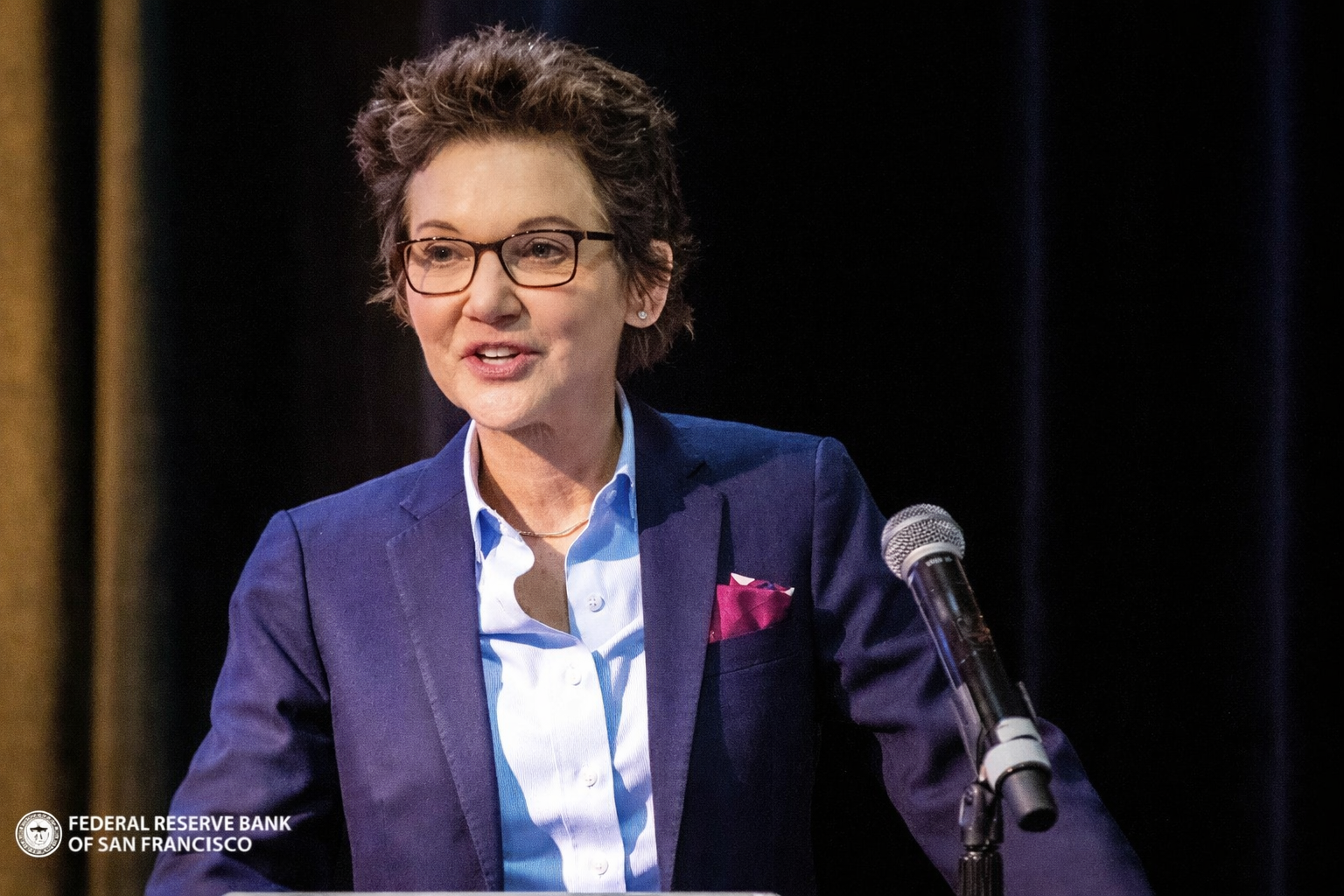
Mary C. Daly, President of the San Francisco Federal Reserve, recently visited San Jose State University as part of an economics roundtable sponsored by the Silicon Valley Leadership Group. In her speech titled “The AI Moment? Possibilities, Productivity, and Policy” Daly acknowledged the growing concerns about AI’s potential for economic disruption but argued that the arc of progress remains too nascent to judge. Daly noted that given AI’s origins date back to the 1930s and 1940s, AI’s development is following a trajectory similar to electricity’s. According to Daly’s historical template, we are just now starting “productivity transformations”. This framing supports her optimistic view that AI-driven productivity could generate net new jobs. Most importantly, Daly wants to “separate facts from fears, speculation from reality, and worst case scenarios from more likely outcomes” as the Fed thinks about policy and workers respond to the AI Moment.
Lessons from the 1990s
Daly reached back to the 1990s to demonstrate that the Federal Reserve is well-equipped to manage monetary policy through the coming transformation, whatever shape it takes. Daly noted that Alan Greenspan, Fed chair at the time, used disaggregated micro data to argue that “the burgeoning computer revolution would spur sustained productivity growth, allowing the economy to grow faster without putting upward pressure on prices”. Thus, the Fed could remain patient with monetary policy even as the economy boomed. Daly did not reference or contextualize the financial chaos that engulfed the late 1990s. The global economy had to survive Russian financial crisis, the Asian financial crisis, the collapse of Long-Term Capital Management, and the ballooning of the tech and dot-com bubble which burst in 2000. Depending on your perspective, monetary policy played alternating roles as savior and villain in these economic calamities.
Going forward, Daly promised that the lessons of the 1990s would inform the foundation of monetary policy’s approach to AI’s impacts on the economy. “The willingness to listen to businesses, hear their ideas, use data and evidence to test them, and invite others to do the same,” Daly recounted as ways to maintain a pulse on AI-driven dynamics.
Daly pointed out that AI can deliver one-time efficiency gains by automating parts of a process. However, that productivity boost does not recur on its own. Sustained productivity growth requires broader reorganization and diffusion across industries. Thus, it is difficult to attribute recent productivity strength to AI or to assume its persistence.
I am particularly intrigued by the notion that the Fed may be slow to respond to a heating economy because of AI-driven productivity enhancements. One of my premises for ongoing sticky inflation includes an economy running hot due to fiscal stimulus and substantial investments in infrastructure and manufacturing. Daly implies that the Fed could be cautious about reacting to inflation that may prove temporary if productivity gains materialize.
Daly noted that AI investment can be inflationary in the near term with the investment required to build out capacity, while the disinflationary channel from productivity may arrive later. Accordingly, timing is central to how the Fed interprets sticky inflation alongside AI.
Thus, developments in AI increase the complexity of interpreting the Fed’s objectives and actions.
Augmentation Not Destruction
While AI could inject disinflationary (or even deflationary) forces into the economy, potential job destruction is top of mind for most workers. Job destruction would present the kind of structural economic force that the Fed typically has minimal ability to influence with monetary policy. Thus, Daly’s optimistic outlook on AI as job augmentation and creation would significantly relieve the Fed of a deeply challenging burden.
Daly’s evidence comes from employers in the San Francisco district. During the fireside chat following the introductory remarks, Daly described her team’s latest findings: “what we’re really seeing is AI replacing tasks, augmenting workers.” Daly and her team are collecting data and anecdotes directly from businesses. According to Daly, “most of those firms are saying, ‘I’m augmenting my workforce’.”
Earlier in the fireside chat, Daly made another call to history to support her optimism: “No technology ever reduces net employment. Not in the history of technologies, but it does change what that employment looks like.” Accordingly, Daly suggested that the same relationships should hold for AI. AI is changing the shape of employment first by replacing tasks within a job and next by augmenting the job itself. For Daly, the next phase for AI and the economy is not wholesale employment destruction but job creation. AI will create new jobs that we cannot imagine in this moment.
Keep Up If You Can
Daly delivered one cautionary message for workers. She warned that workers will need to engage with AI and focus on continuous (and rapid) learning. She referred to the leader of a company who had fired workers who were not able to keep pace. Fortunately, that same leader discovered the need to hire more workers because of the opportunities created by AI.
Daly also used prompt engineering as an example of a job type that emerged and faded quickly because of the changing needs and capability of AI. As a result, Daly advised workers to run as fast as they can:
“work forces need to skill in durable skills…be AI ready, be able to use AI to lift yourself in the educational space. You know, use the technologies that are out there to build your skills up because you can learn a lot fast if you train yourself to look at AI…”
In other words, translate AI into a learning advantage instead of treating AI as a threat.
Conclusion
Overall, Daly struck a positive tone on the current “AI Moment”. While the path forward is uncertain, Daly made the case for a kind of resilience informed by direct experience with AI. Workers need to engage with AI using a growth mindset, looking for opportunities while avoiding threats. In the meantime, the Federal Reserve will remain forward-looking and evidence-driven, monitoring whether AI’s anticipated effects are materializing in productivity, prices, and employment before adjusting policy.