


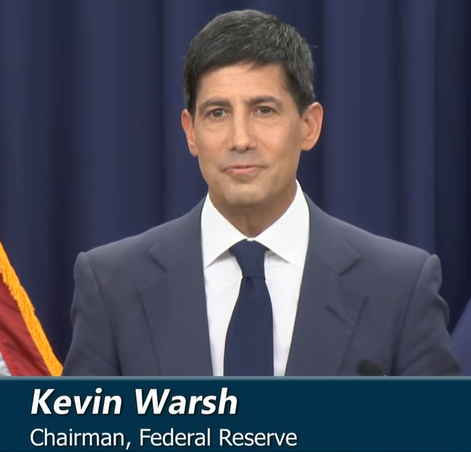
If you are a Federal Reserve Chair appointed to cut interest rates, the last thing you want to do in your first press conference is announce that rate hikes are necessary to meet the Fed’s 2% inflation target. A rate-hike warning would collide with the expectations that helped put you in the chair. Moreover, a rate-hike warning also risks shocking financial markets.
In his first press conference as Fed Chair, Kevin Warsh found another way to talk up and reaffirm the Fed’s credibility on inflation. He shortened the policy statement to focus on what he called the ”facts,” removed forward guidance, repeatedly invoked the Fed’s commitment to “price stability,” and launched task forces designed to produce strategic and operational reforms for some time in the future.
Fighting Inflation With Jawboning
In his opening remarks, Warsh insisted that “members of the FOMC are unambiguous and unanimous. This Committee will deliver price stability.” He returned to the same jawboning when asked about inflation and the Fed’s ability to bring inflation back to target: “Today, I am announcing that this Committee has unambiguously and unanimously decided that we are going to deliver on that.”
Given the lack of forward guidance, Warsh’s repetition and reemphasis came without defining what the commitment means for the next rate decision. This approach is classic central-bank jawboning. The posturing gives Warsh room to maintain hawkish credibility without committing the FOMC to a near-term rate hike.
The most revealing moments came when Warsh responded to questions about the restrictiveness of current policy. He described monetary policy’s restrictiveness as “uneven.”
“If I look at the housing market as one example,” Warsh said, “Fed policy is not the single determinant of the state of the housing market, but broadly, I would say Fed policy appears to be somewhat restrictive there.” Warsh contrasted housing with financial markets. “I would have a hard time saying those words if I were looking at what is happening in financial markets.” That observation alone could have been sufficient to knock the S&P 500 (SPY) down 1.2% on the day and position it for another test of its uptrending 50-day moving average (DMA) support (the red line below).

Warsh made a similar point later in the press conference: “I do see some restrictiveness in things like housing. It is hard to use those same words anywhere else.” In other words, there is little to no case for cutting rates when the majority of the economy and financial markets are not behaving as if monetary policy is restrictive.
And for Further Emphasis…
In response to a question about underlying inflation pressures in the economy, Warsh pointedly emphasized the message from the statement on monetary policy: “…to be clear, the Fed will deliver price stability.” He again described the Fed’s commitment to price stability as “strong, unanimous, and unambiguous.” Warsh called this commitment “an important message we have missed for five years” and promised, “we are going to fix that.”
Warsh’s insistence and emphasis build the credibility behind the jawboning. The end of forward guidance avoids pre-committing to a rate path that at this time would have to point to higher rates. Warsh wants to pre-commit to an outcome. The outcome is 2% inflation. The path is deliberately unspecified except through the work of task forces.
There’s A Task Force for That
The task forces were a pillar of Warsh’s first press conference. He announced the launch of five task forces: Fed communications, the Fed’s balance sheet, data sources, productivity and jobs in an era of technological transformation, and inflation frameworks. Warsh said the groups will “start with first principles, ask hard questions, examine current practice, consider alternatives, and ultimately propose next steps for policymaker consideration.”
The inflation task force bolstered the jawboning on inflation. Warsh said, “The last task force, the one on inflation frameworks, will examine the drivers of inflation, first principles, and weigh the full range of ideas for delivering price stability in a changing economy.” Since the Fed already wields substantial inflation expertise in the Cleveland Fed’s Center for Inflation Research, I am keenly interested in the makeup of this task force and the institutional response to its work. I also wonder whether Warsh will advocate for delays in changing monetary policy until this task force completes its work.
Warsh even deferred to the task force when asked whether he still believes AI-driven productivity gains pave the way to rate cuts. When asked whether productivity could justify lower rates, he shifted the issue to the new productivity and jobs task force. He said the task force will examine “timing, scale, speed, implications for output and employment.”
Confidence In Price Stability, Not the Path to Get There
Ironically, Warsh sounded most confident when discussing the things he believes the Fed can control, and least confident when discussing forecasts. He repeatedly showed confidence in the Fed’s ability to deliver price stability. He expressed little confidence in the effectiveness of the Fed’s rate projections.
That contrast may define his chairmanship. Forecasts are uncertain. Dots can be erased. Forward guidance can mislead. But inflation, in Warsh’s telling, is ultimately a monetary-policy choice.
“You bet it is,” he said when discussing the idea that inflation is primarily determined by monetary policy. “I’ve said for years, inflation is a choice. You bet it is.”
Once again, Warsh postured as hawkish without overtly committing to rate hikes. If inflation is a choice, and inflation remains above target, then the Fed is responsible for choosing differently. Rate cuts do not bring inflation down (just ask the Turkish Central Bank).
Reporters tried repeatedly to nudge Warsh into acknowledging rates must go higher. He steadfastly refused each time. For example, when asked why the Fed did not raise rates given the inflation risks, he answered curtly: “I’ve got nothing more to say than the statement itself.”
Still, when asked whether there was any discussion of a rate cut, Warsh dismissed the idea quickly: “There was one proposal on the table. There was no discussion of any other proposals. The discussion on that proposal was, I would say, quite limited. The group was unanimous and unambiguous on it.” Any lingering hopes for a rate-cut narrative officially died at that point. Perhaps the new narrative is possible now that the FOMC does not include a voting member who requests rate cuts no matter what the data say.
Conclusion
Warsh is targeting inflation credibility through communication before leaning on the interest-rate weapon. He seems to be buying time for inflation to cool on its own accord (transitory without calling it transitory). However, given inflation has remained sticky for years and is now creeping higher, time is not on his or the Fed’s side.
Yet, the latest Summary of Economic Projections (SEP) projects a Fed-standard glide path to the Fed’s target in another two years…

Regardless, toward the end of the press conference Warsh proclaimed a credibility argument underlined the jawboning: “When we deliver on our price-stability objectives, which we will, the American people will feel as though the hardships they have been living through, in part because of inflation over the last five years, are in the rearview mirror. That credibility will have dividends across what we do.”
The market question is whether Warsh can make this promise credible without first proving he and the FOMC are willing to raise rates. I am betting they continue to find ways to avoid rate hikes for the rest of the year absent a calamitous turn of monetary events.
Warsh’s war on inflation started with jawboning and the new Fed Chair used his first press conference to establish inflation-fighting seriousness without directly threatening tighter policy.
Two comments:
-1-
Warsh mentioned that the Fed has two tools: the FF rate, and the size of their balance sheet. The former primarily affects short-term rates; the latter, long-term rates. Warsh also mentioned (and admitted it was the only example he could point to) housing market rates are restrictive. Certainly, lowering long-term rates improves that market, because mortgage rates effectively determine housing affordability. So, will the Fed start purchasing LT treasuries, which until recently it had been selling?
-2-
«When asked whether there was any discussion of a rate cut, Warsh dismissed the idea quickly: “There was one proposal on the table. There was no discussion of any other proposals. The discussion on that proposal was, I would say, quite limited. The group was unanimous and unambiguous on it.”»
I think it is probable that the rate cut proposal was a Miran leftover… but it is also possible that Warsh himself put that proposal on the table.
Oh man. That would be hilarious if Warsh was talking about his own rate cut proposal! Surely he would have only made it to provide evidence to the President that he tried.
That’s an adequate reason for doing it. Another would be to get a sense of support for it, maybe find any hiding doves. Regardless of who put it on the table, I guess what was found was… crickets :-}.
There is just zero credible way to get to rate cuts….and even less so now than at the beginning of the year.
And imagine if Powell and the FOMC DID cut rates earlier this year. There would be a mad scramble to undo at least one cut and then for good measure undo one or two more!
I forgot to mention that my take from the press conference commentary is that Warsh suspects the balance sheet’s size is providing too much liquidity for financial markets. But I would like to hear him state his opinion directly on this one.